
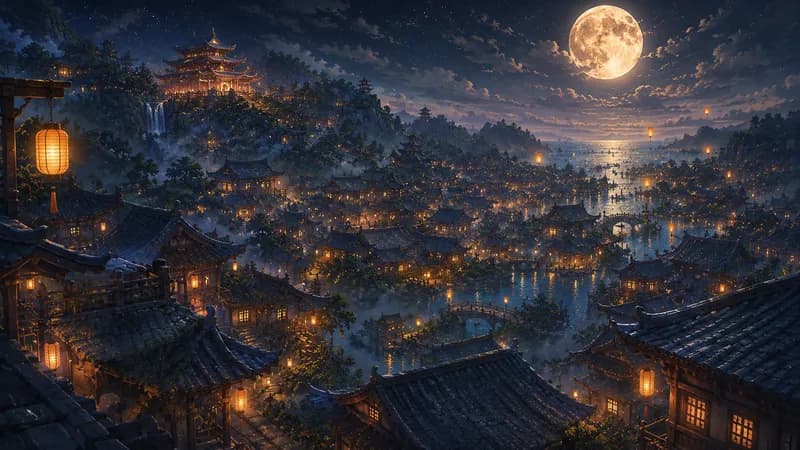
World Brief · Aokujima Trilogy — Film C
KAGAMI-1
Future Aokujima. The memory archive. A descent into what remains.
KAGAMI means "mirror" in Japanese. The KAGAMI-1 is a mirror-archive vessel — a descent craft designed to interface with places that hold residual memory. It is not a drill. It does not extract resources. It reflects them.
What she finds is not a resource to extract, but the last living memory of the island itself.
The Story
The Archive Finds What It Was Not Looking For
Rin — Kaede's granddaughter — works for the KAGAMI Archive, a future memory-preservation project built to recover memories from disappearing places. During a routine descent into Aokujima's sealed mirror chamber, she hears the same melody Kaede once played beneath the neon boardwalk. The KAGAMI archive interface looks like a mirror. What the mirror shows her is not geological data. It is memory: lantern light, a brass bell ringing once, an old stencil pattern that also happens to be the access key.
The phrase that completes the descent — "A memory shared becomes light" — closes the trilogy.
Character
Rin
Role
KAGAMI Archive technician · Kaede's granddaughter · third generation of the Luma lineage
Visual
Archive technician uniform. The cracked brass bell — originally Luma's, patinated through Kaede's time — worn on her archive harness. The bell is the only warm-toned element on her person.
Arc
Methodical descent → unexpected musical recognition → emotional contact with the island's memory → the phrase that closes the trilogy
What she carries
- ✦ The cracked brass bell from Luma (Film A) → Kaede (Film B) → Rin (Film C)
- ✦ The lantern stencil pattern as the archive access key
- ✦ The phrase: "A memory shared becomes light" — the final unlock
Yellow Raincoat
Seen only as a recovered memory projection inside the KAGAMI archive signal — the family's thread made visible one final time.
Visual Identity
Semi-Real Cinematic. Archive Teal. One Warm Light.
Production style
Semi-real cinematic. Physically-grounded lighting and high-fidelity character continuity. The hardest production test of the trilogy.
Color palette
Archive teal + brushed steel as the dominant language. The shrine lantern is the only warm light source in any archive-era frame.
Architecture
Rectilinear archive architecture frames the natural curves of the Aokujima coast. The shrine stands at the intersection — unchanged across three eras.
KAGAMI-1 vessel
Mirror-archive descent craft. The interface looks like a mirror. NOT a mining vehicle, NOT a deep-sea drill, NOT resembling any real-world submarine (Alvin, DSV Limiting Factor). Fully original design.
The mirror chamber
The sealed chamber beneath the Aokujima shrine where residual memory has gathered. Deep-mirror cinematography. Warm amber memory-contact shot as the emotional climax.
Studio bans
No mineral extraction, no resource survey, no corporate-villain framing. KAGAMI preserves memories. It does not own them.
What fits
- ✦The KAGAMI archive interface that looks like a mirror, not a machine
- ✦The brass bell worn on Rin's harness — cracked but resonant
- ✦The lantern stencil as the archive access pattern
- ✦Memory-contact visuals: warm amber in an otherwise cold frame
- ✦The melody recognized in the archive signal
- ✦Rin saying the final phrase to the interface
What does not fit
- —Mineral extraction or resource survey framing
- —Corporate-villain storyline
- —KAGAMI-1 design resembling any real submarine or deep-sea vehicle
- —Warm lantern light without a story justification
- —Industrial port lights or heavy machinery
- —The archive "owning" or "claiming" the island's memories
Pitch Your KAGAMI-1 Idea
Archive sequences, mirror-chamber environments, memory-contact visuals, and the descent cinematics that close the Aokujima trilogy.